Award-Winning AP Physics C: Mechanics Tutors
serving Dayton, OH
Who needs tutoring?
FEATURED BY


TUTORS FROM
- YaleUniversity
- PrincetonUniversity
- StanfordUniversity
- CornellUniversity
Award-Winning AP Physics C: Mechanics Tutors serving Dayton, OH

Certified Tutor
9+ years
Justin
Three years of tutoring introductory physics students while completing dual bachelor's degrees in physics and mathematics — followed by a PhD in Computational Mathematics — means Justin has taught the calculus-based mechanics in AP Physics C from both sides of the chalkboard. He digs into the spots ...
Washington University in St. Louis
Bachelor's in Physics and Mathematics
University of Chicago
Doctor of Philosophy, Computational Mathematics

Certified Tutor
10+ years
Jonathan earned his PhD in physics, which means the calculus-based mechanics in AP Physics C — from deriving equations of motion for coupled oscillators to setting up torque integrals for non-uniform rigid bodies — is territory he's navigated at a research level. His teaching fellowship during gradu...
University of Chicago
PHD, Physics
Vanderbilt University
Bachelors
Certified Tutor
9+ years
Dennis
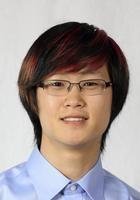
Simulating cosmic ray acceleration through turbulent plasmas requires exactly the kind of calculus-based mechanics reasoning that AP Physics C tests — Newton's laws applied to complex systems, rotational dynamics, and energy methods. Dennis walks students through the hardest problems on the exam by ...
Princeton University
Bachelor of Science

Certified Tutor
8+ years
Pratik
Cornell pre-med students rarely double down on calculus-based physics, but Pratik tutors AP Physics C: Mechanics alongside AP Chemistry and AP Biology — giving him a cross-disciplinary lens that's especially useful when mechanics problems involve biological or chemical systems in free-response scena...
Cornell University
Bachelor in Arts, Biology, General

Certified Tutor
8+ years
Three physics degrees and a 1570 SAT give Bryan the kind of deep mathematical fluency that AP Physics C: Mechanics rewards — particularly on problems where students need to set up differential equations for non-uniform circular motion or derive momentum impulse through integration. He teaches the co...
Duke University
Bachelor of Science

Certified Tutor
9+ years
Derek
Scoring a 5 on both AP Physics C: Mechanics and AP Calculus BC while taking 16 AP courses total, Derek built the habit of connecting calculus tools to physical intuition under real exam pressure — and he brings that same efficiency to tutoring. His computer science major at Harvard sharpens his appr...
Harvard University
Bachelor in Arts, Computer Science

Certified Tutor
8+ years
Bettina
Bettina didn't just study mechanics in a textbook — she earned a PhD in mechanical engineering, meaning she's derived equations of motion for real systems where assumptions about friction, constraints, and rigid-body approximations actually matter. That depth shows up when she teaches AP Physics C: ...
Massachusetts Institute of Technology
Bachelor of Science, Mechanical Engineering
Georgia Institute of Technology-Main Campus
Doctor of Philosophy, Mechanical Engineering

Certified Tutor
6+ years
Emily
Emily's computational biology major at Cornell pairs heavy calculus and physics coursework with programming — a combination that trained her to model real systems mathematically, which is exactly what AP Physics C: Mechanics demands when a problem asks you to integrate a variable force or derive an ...
Cornell University
Bachelor in Arts, Computational Biology

Certified Tutor
8+ years
Dylan
Dylan's physics major at Vanderbilt means he's working through the same calculus-based Newtonian mechanics — torque integrals, rotational kinematics, differential equations for oscillating systems — that AP Physics C: Mechanics demands, and his 36 ACT reflects the quantitative precision that carries...
Vanderbilt University
Bachelor of Science, Physics

Certified Tutor
6+ years
Michael
Designing control systems for Northwestern's solar car means Michael applies Newtonian mechanics, rotational dynamics, and energy conservation principles daily — the exact topics AP Physics C: Mechanics tests. He teaches students to translate word problems into free-body diagrams and then into the c...
Northwestern University
Current Undergrad Student, Electrical Engineering
Practice AP Physics C: Mechanics
Free practice tests, flashcards, and AI tutoring for AP Physics C: Mechanics
Other Dayton Tutors
Related Science Tutors in Dayton
Frequently Asked Questions
AP Physics C: Mechanics is a calculus-based physics course that goes deeper into motion, forces, and energy than AP Physics 1. While AP Physics 1 uses algebra and basic trigonometry, AP Physics C: Mechanics requires calculus to solve problems—you'll work with derivatives and integrals to analyze motion and forces. This makes it ideal for students planning to study engineering, physics, or other STEM fields in college.
Score improvement depends on your starting point and consistency, but students typically see meaningful gains when they work with an expert tutor on problem-solving strategies and conceptual understanding. Many students jump from a 2 or 3 to a 4 or 5 by focusing on the specific question types on the exam, practicing free-response problems under timed conditions, and filling in calculus gaps. The key is identifying your weak areas early—whether that's kinematics, energy, or rotational motion—and drilling those topics systematically.
The biggest hurdles are typically calculus integration (setting up and solving integrals for motion problems), understanding rotational dynamics, and managing time on the free-response section. Many students also struggle with connecting physical intuition to mathematical representations—knowing when to use energy methods versus force methods, for example. Additionally, the exam rewards precise problem setup and clear communication of reasoning, which requires practice beyond just getting the right numerical answer.
Most students benefit from starting preparation 3-4 months before the exam in May, which gives you time to cover all units (kinematics, dynamics, energy, momentum, rotation, and oscillations) and complete multiple practice tests. However, if you're taking the course for the first time, consistent weekly tutoring throughout the school year—even just 1-2 hours per week—helps reinforce concepts as you learn them. The goal is to avoid cramming and instead build problem-solving fluency over time through spaced practice.
Your first session will focus on understanding where you stand: a tutor will review your current coursework, assess your calculus skills, and identify which topics feel strongest and weakest. You might work through a sample problem or two to see your approach to problem-solving, then create a personalized study plan based on your goals and timeline. This foundation helps ensure every future session targets exactly what you need to improve.
Practice tests are essential—they show you the exact question format, help you manage the 90-minute time constraint, and reveal which concepts need more work before exam day. The best approach is to take full-length practice tests under timed conditions every 2-3 weeks during your prep period, then review them carefully with a tutor to understand not just what you got wrong, but why. This combination of timed practice and targeted review builds both confidence and competence.
Varsity Tutors connects you with expert tutors for AP Physics C: Mechanics for students in Dayton who understand the course curriculum and exam format. When you get matched with a tutor, you can discuss your specific needs—whether you need help with calculus foundations, rotational dynamics, or test-taking strategy—and work together on a schedule that fits your life. Many tutors have experience helping Dayton-area students move from struggling with concepts to scoring 4s and 5s on the exam.
Test anxiety often stems from uncertainty about whether you can solve problems under pressure. Working with a tutor on repeated timed practice, building a toolkit of problem-solving strategies, and reviewing your mistakes builds genuine confidence—not false reassurance. As you see yourself successfully tackling harder problems and improving your scores on practice tests, anxiety naturally decreases because you know you're prepared.
Connect with AP Physics C: Mechanics Tutors in Dayton
Get matched with local expert tutors