Award-Winning 6th Grade Biology
Tutors
Who needs tutoring?
FEATURED BY


TUTORS FROM
- YaleUniversity
- PrincetonUniversity
- StanfordUniversity
- CornellUniversity
Award-Winning 6th Grade Biology Tutors

Certified Tutor
5+ years
Pallavi
From cells to ecosystems, 6th grade biology introduces a huge range of living-world concepts in a short time. Pallavi's neurobiology training at Penn gives her a deep understanding of how organisms work at every level, and she uses that depth to answer the "but why?" questions that curious middle sc...
University of Pennsylvania
Master's in Biology
University of Pennsylvania
Bachelor of Arts in Biology (Neurobiology concentration)

Certified Tutor
5+ years
Karista
At the 6th grade level, biology is about sparking curiosity around living systems — how cells function, how organisms are classified, how ecosystems stay in balance. Karista's research in environmental science and her experience teaching biology labs means she can turn topics like food webs and plan...
University of North Texas
Master of Science, Environmental Science
Oklahoma State University-Main Campus
Bachelor of Science, Biochemistry
University of Windsor
Doctor of Philosophy, Environmental Science

Certified Tutor
6+ years
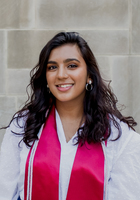
Emily
Sixth graders are often encountering real scientific vocabulary for the first time — cell organelles, photosynthesis, food webs — and Emily knows how to make those terms stick. Her psychology background means she understands how younger learners process and retain new information, and she builds les...
Johns Hopkins University
Master of Science, Education
Millersville University of Pennsylvania
Bachelor in Arts, Psychology
Certified Tutor
6+ years
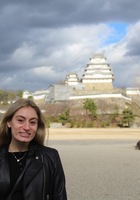
Mariam
At the 6th grade level, biology should spark curiosity — why do leaves change color, how do cells divide, what makes a species a species. Mariam connects these introductory concepts to vivid real-world examples, drawing on her broad biology background that spans ecology, plant biology, and genetics....
Indiana University-Bloomington
Bachelor of Science, Biology, General
Certified Tutor
6+ years
Remy
At the 6th grade level, biology is all about sparking curiosity — what makes something alive, how do organisms get energy, why do offspring look like their parents. Remy brings that excitement naturally; her neuroscience studies at Oberlin started with the same fundamental questions, just at a deepe...
Oberlin College
Bachelor in Arts, Neuroscience

Certified Tutor
6+ years
Ritu
At the 6th grade level, biology is all about sparking curiosity — why do leaves change color, how do cells divide, what makes a species a species. Ritu taps into that natural curiosity by anchoring every lesson in a question students actually want answered, then walking them through the science behi...
UNC Chapel Hill
Bachelor in Arts, Biology, General

Certified Tutor
6+ years
Brittany
At the 6th grade level, biology is often a student's first real encounter with scientific thinking — forming hypotheses, classifying living things, and understanding how cells function as building blocks. Brittany introduces these ideas through hands-on examples, like tracing how nutrients move thro...
Duke University
Bachelor of Science, Biology, General
Certified Tutor
2+ years
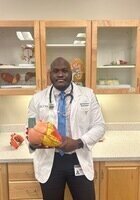
Malik
As a second-year medical student with a strong foundation in science and a passion for education, I specialize in making tough subjects easier to understand. I excel in math, biology, physics, and other challenging topics that often intimidate students and I genuinely enjoy helping others master th...
University of North Carolina at Charlotte
Bachelor's
Certified Tutor
2+ years
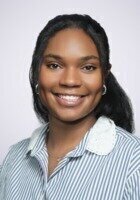
Alana
Whether the topic is plant cells, animal adaptations, or basic ecology, 6th grade biology rewards curiosity — and Alana knows how to channel it. Her Yale education in the history of science and medicine means she can turn a lesson on classification or photosynthesis into a story that keeps younger s...
Yale University
Bachelor's

Certified Tutor
Kate
I'm available to tutor biology, chemistry, physics, math from Algebra up through AP Calculus, SAT test prep, and French. I've been tutoring students in science and math for 7 years. I also spent 8 months working and studying in France, and have tutored high school and adult students in French. When ...
Massachusetts Institute of Technology
Masters, Environmental Engineering
Massachusetts Institute of Technology
Bachelors
Top 20 Science Subjects


Meet Varsity Tutors Experts
Connect with highly-rated educators ready to help you succeed.
Jessica
College Algebra Tutor • +51 Subjects
I am a licensed physician from Florida who is currently changing careers. I graduated from the University of Pennsylvania in 2009 and have extensive tutoring and editing experience. While a student, I became a certified writing tutor through the Critical Writing Department. Since I completed my writing requirement at the University prior to matriculating, I was the first freshman tutor to be accepted into this selective program. The tutoring program involved a preliminary peer-tutor training course prior to beginning tutoring, in order to certify that I had the appropriate background to provide professional feedback to fellow students on their literary works and projects. After graduation, I worked for a full-service learning center where I created and implemented high school lesson plans for home-schooled students, provided academic support for students ranging in ages from 8 to 20 years old, and taught group and individual standardized testing preparation classes. I have also assisted students with application essays for various undergraduate and graduate programs.
Jai
Calculus Tutor • +23 Subjects
I'm a recent Stanford graduate (Electrical Engineering and Computer Science), and have been working at a major Management Consulting firm for a few years now. I personally scored a 2360 (out of 2400) on the SAT and 35 on the ACT and was successful in gaining admission to several top universities. I'm looking forward to helping you improve your scores towards improving your chances at getting in to your dream school.
Erika
Pre-Algebra Tutor • +36 Subjects
I am available to tutor middle and high school math, history and test prep. I have tutored math and history in the past and I previously taught a test prep course at a school in Hanoi, Vietnam. I have a lot of experience teaching all the need-to-know tricks to doing great on the SATS/ACTS! When I am not in school myself, I love rowing, equestrian and exploring my new city of Boston! I look forward to meeting and working with you soon!
Rhea
AP Statistics Tutor • +49 Subjects
I am a current student at the University of Chicago. I am working towards a Bachelor of Science in Biological Sciences, and I am on the pre-medical track. I am extremely passionate about tutoring, and I have several years of experience tutoring students in my high school's learning center in various subjects as well as tutoring private clients in Standardized Test preparation. Given that I graduated high school recently, I have taken several Standardized Tests and high school subjects myself, so I have a comprehensive understanding of not only how to tutor these subjects and exams, but also what it is like to take them. While I have a wide range of interests and am able to tutor various subjects, I am most passionate about tutoring in Standardized Test preparation (including ACT, SAT, SAT Subject Tests, and AP Exams), Biology, Chemistry, Math, and Spanish. I truly believe that students should have the opportunity to learn in the way that works best for them, and I love being able to help them succeed by creating a comfortable tutoring environment in which we can best assess their particular needs and use strategies specific to them. My passion for learning drives everything that I do, and tutoring is the platform that I use to try to spread that passion to others. In my free time, you can find me playing badminton, listening to music, or baking something (hopefully) delicious.
Jeffrey
Pre-Calculus Tutor • +29 Subjects
I am enrolled in the Mechanical Engineering PhD program at Rice University which will begin Fall 2020, and I am hoping to return to academia as a professor after earning my PhD. In the meantime, I am looking to share my passion for gaining knowledge, specifically in STEM, by educating the up and coming members of such a great field. I have experience tutoring both Calculus and Physics at Notre Dame, as well as experience as a Student Assistant for Differential Equations and Mechanics. I believe the key to learning is much deeper than learning to solve problems and that seeking knowledge is one of the best means for personal improvement.
Earnest
Pre-Algebra Tutor • +26 Subjects
I am comfortable with either setting. I'm confident that I can help you (or your student) achieve to the best of their ability, so please don't hesitate to get in touch!
Sharon
Pre-Algebra Tutor • +29 Subjects
I am a graduate of the University of Chicago, and I will be starting a graduate program at Columbia in August. I am about to complete a year of service with City Year, an education non-profit that places young adults into under-served schools. As a City Year member, I worked full-time in the classroom with middle-school students who were in approximately the 10th percentile for math (meaning they score lower than 90% of students). One-fourth of those students were able to grow around 15 percentile points by the end of the year! Hobbies: reading, cooking, gardening, music, art, nature, books, writing
Samantha
Pre-Algebra Tutor • +38 Subjects
I'm a first-year medical student and recent graduate from Duke University, where I studied Global Health Determinants, Behaviors, and Interventions. From running a piano program at a nonprofit children's theatre to private tutoring in math, science, and standardized test prep, I enjoy helping my students become confident and self-sufficient learners! Hobbies: photography, travel, reading, music, writing, running, art, books, traveling
Zachary
Trigonometry Tutor • +35 Subjects
I am passionate about teaching and tutoring and I thoroughly enjoy helping students gain an understanding and a drive for their studies. I have a long history of working with students of all grade levels and abilities (elementary school through college), and I have a good understanding of strategies to excel in both general academics and standardized tests.
Sami
Pre-Algebra Tutor • +19 Subjects
I am a Duke University graduate in Economics and Computer Science. I am currently pursuing an MBA degree at the Yale School of Management. I have worked in the financial field, both at a management consulting firm and a fortune 500 company. My hobbies include playing and coaching soccer. Hobbies: reading, writing, art, books, music
Top 20 Subjects
Frequently Asked Questions
Students often find cell structure and function challenging—understanding the difference between plant and animal cells, and what organelles like the mitochondria and chloroplast actually do, requires both memorization and conceptual understanding. The life cycles of organisms (from plants to insects to frogs) also trip up many students because they involve multiple stages and transitions that don't always follow intuitive patterns. Additionally, ecosystems and food chains require students to think about relationships and energy flow, which is more abstract than memorizing facts. A tutor can break these concepts into digestible pieces and use visuals or real examples to make them stick.
Many 6th graders struggle to connect what they observe in a lab to the scientific concepts they're learning—they might see cells under a microscope but not understand what they're actually looking at. Tutors help students develop stronger scientific reasoning by walking them through the "why" behind each step: Why are we staining the cell? What does this observation tell us about cell structure? This approach transforms labs from just "following steps" into genuine learning experiences. Tutors can also help students design their own mini-experiments and troubleshoot when results don't match expectations, building critical thinking skills alongside content knowledge.
True mastery requires both, but understanding must come first. For example, memorizing that "mitochondria is the powerhouse of the cell" means nothing if a student doesn't understand what energy is or why cells need it. A tutor focuses on building conceptual foundations—using analogies, diagrams, and real-world examples to explain *why* things work the way they do. Once that foundation is solid, memorization becomes much easier and more meaningful. This approach also helps students retain information longer and apply it to new situations, rather than forgetting facts after a test.
6th graders are concrete thinkers, so abstract concepts like "what's inside a cell" or "energy flow through an ecosystem" need to be made tangible. Tutors use multiple strategies: drawing and labeling diagrams together, using physical models or analogies (like comparing a cell to a factory), and connecting concepts to things students can actually see or experience. For example, instead of just describing photosynthesis, a tutor might have a student observe a plant in sunlight and discuss what's happening inside the leaves. Video animations and interactive tools can also help, but the key is having someone guide the student through what they're seeing and connect it back to the concept.
Beyond knowing the content, an effective 6th Grade Biology tutor needs to explain concepts in multiple ways—because what works for one student won't work for another. They should be comfortable with hands-on learning, able to design or suggest simple experiments, and skilled at asking questions that guide students to their own understanding rather than just giving answers. Strong tutors also recognize that 6th graders are developing abstract thinking skills, so they bridge the gap between concrete observations and larger concepts. Finally, they should be patient with the messy, non-linear nature of learning biology—students often need to revisit concepts multiple times before they truly click.
Many 6th graders view the scientific method as a checklist to complete rather than a way of thinking. Tutors help students understand that science is about asking questions, making observations, and testing ideas—skills that apply far beyond biology. When working through a concept or lab, a tutor encourages students to predict outcomes before observing them, then explain *why* their prediction was right or wrong. This builds the habit of thinking critically and testing assumptions. Over time, students develop genuine scientific curiosity and confidence in their ability to figure things out, rather than just memorizing what the textbook says.
For students struggling with fundamentals, a tutor slows down and builds foundational understanding—ensuring they grasp what a cell is before diving into organelles, or what an ecosystem is before studying food chains. For students who understand the basics but struggle with application, tutors focus on connecting concepts and solving multi-step problems. For advanced students, tutors can deepen their thinking by exploring "why" questions, designing their own investigations, or connecting 6th grade biology to more complex topics. Personalized 1-on-1 instruction means the tutor adjusts pace, complexity, and approach based on exactly where each student is, rather than following a one-size-fits-all curriculum.
Effective test prep goes beyond cramming facts the night before. A tutor helps students identify which concepts they truly understand versus which ones they've only memorized, then focuses study time where it matters most. They practice applying knowledge to new scenarios—like identifying an unknown organism's characteristics or predicting what would happen if an ecosystem lost a key species—rather than just reciting definitions. Mock quizzes with feedback, creating study guides together, and discussing common test question formats all build confidence. The goal is helping students think like biologists during the test, not just recall isolated facts.
Connect with 6th Grade Biology Tutors
Get matched with expert tutors in your subject